
Articles How Does a Composting Toilet Work? Waterless Toilets Explained
Eemeli profile picture waterless toilet shop

Eemeli Palo

Waterless Toilet Expert
📱(702) 328 0689
✉ info@waterlesstoiletshop.com

How Does a Composting Toilet Work? Waterless Toilets Explained

No water. No sewer. No septic tank. Here is what actually happens inside a waterless toilet — and why a well-built one does not smell.

That is the two-minute version. The rest of this page is the same thing in more detail, including the one design decision that separates a waterless toilet you would happily have indoors from one you would not.

Start with what a flush toilet actually needs

Every flush sends clean drinking water down a pipe, and that pipe has to go somewhere — a municipal sewer, or a septic system on your own land. On a serviced lot you never think about it. On a cabin lot, a steep parcel, a tiny home or an ADU, that second half is the whole problem. A septic system has to be permitted, excavated and maintained, and on difficult ground it is the single most expensive thing about adding a bathroom. Sometimes the soil or the setbacks mean it simply cannot be done.

A waterless toilet removes the pipe from the equation. Nothing leaves the room in a drain, so there is nothing to connect to.

What happens when you use one

You use it like any other toilet. There is no flush and no water, so waste and toilet paper fall straight down into a chamber below the seat.

Inside that chamber, the same microorganisms that break down material in a garden compost heap get to work. They need three things to do it well: air, the right moisture level, and time. Almost every design decision in a good waterless toilet exists to supply one of those three.

Covering material

After use, many systems ask for a cupful of covering material — hemp, peat or a similar dry carbon source — sprinkled over the top. It is not there to mask a smell. It adds carbon to balance the nitrogen in the waste, and it keeps the surface of the pile open so air can get in. You can also add a larger amount less often, weekly rather than each time.
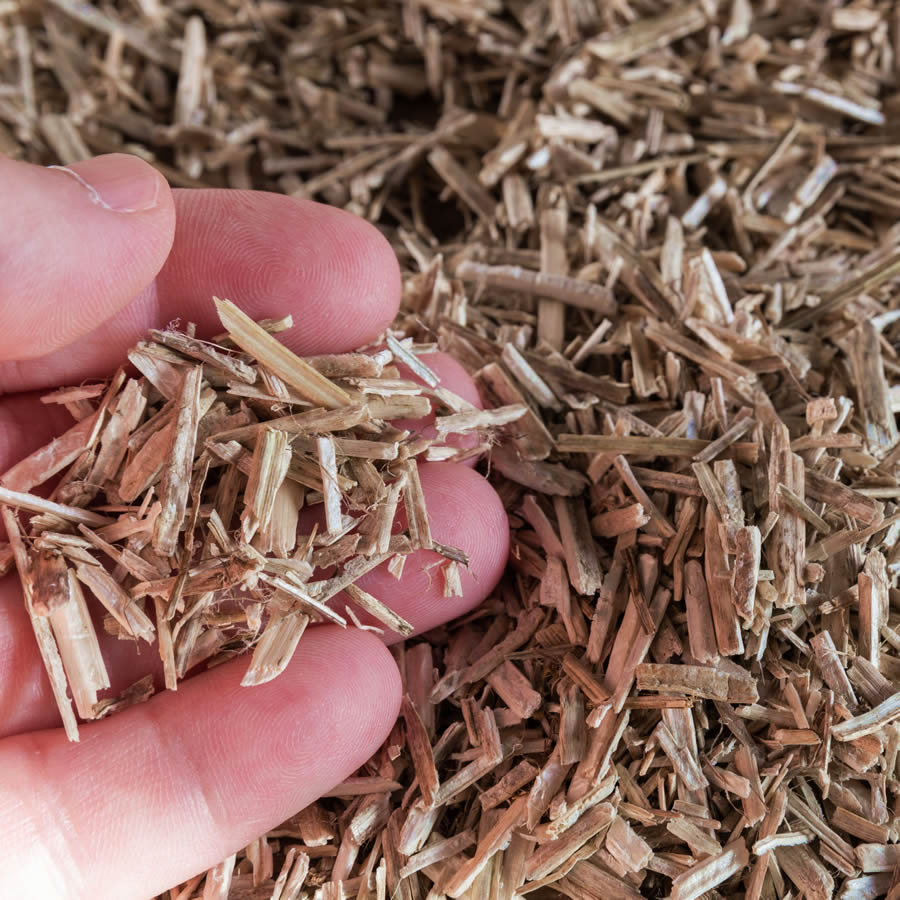
A handful of chopped hemp covering material held over a larger pile of it

The three things that make it work: liquid is drained away from the solids, air is pulled through the chamber and out a vent pipe, and the material is given time. Get those three right and the room smells of nothing at all.

Liquid separation — the part that decides whether it smells

This is the step people miss, and it is the one that matters most.

Solid waste on its own composts quietly. Solids sitting in liquid go anaerobic — the oxygen-breathing bacteria die off, the ones that replace them produce ammonia and hydrogen sulphide, and that is the smell people associate with a bad outhouse. It is not an inevitable feature of a waterless toilet. It is what happens when liquid is allowed to pool.

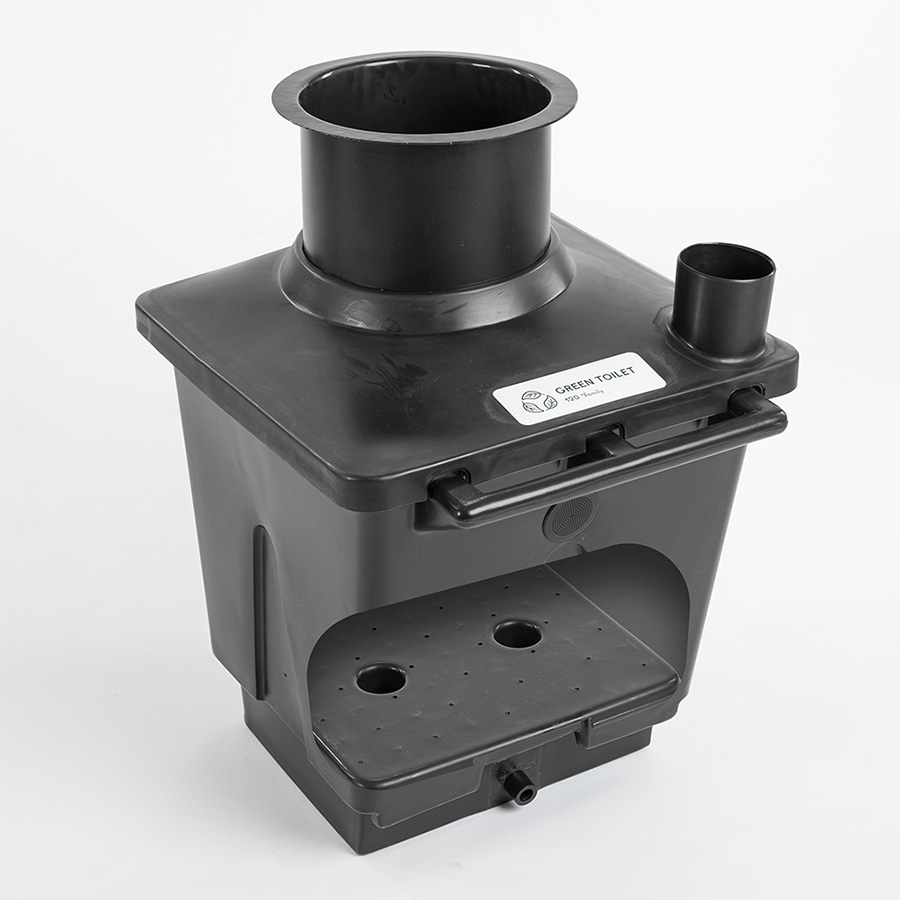
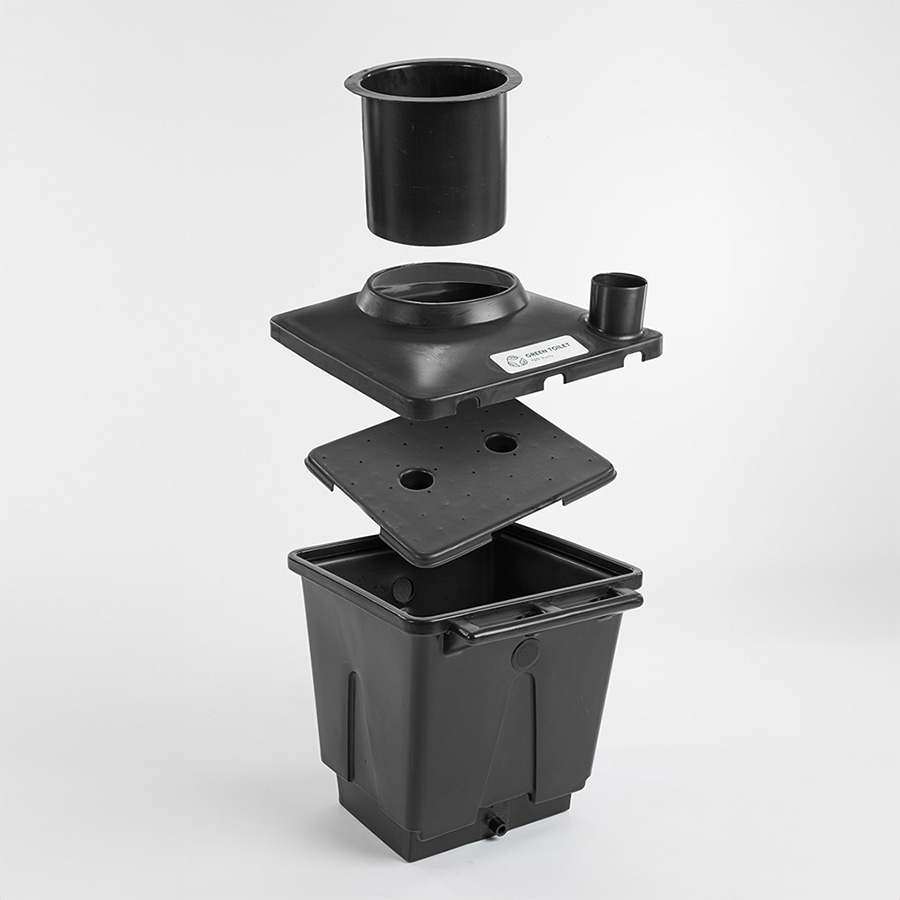
So the chamber is built to get liquid away from the solids, and there is more than one way to do it. Many of our systems use a double-base design: urine and solids go into the bin together, most of the liquid is absorbed and evaporates away through the ventilation, and only the excess the solids cannot hold drains through the double base and out of a liquid outlet underneath — to a gravel soakaway or a separate container, depending on what your site allows. Others separate at the source, with a urine-diverting pedestal that sends liquid down its own outlet before it ever reaches the solids.

Either way the principle is the same: keep the pile damp, never wet.
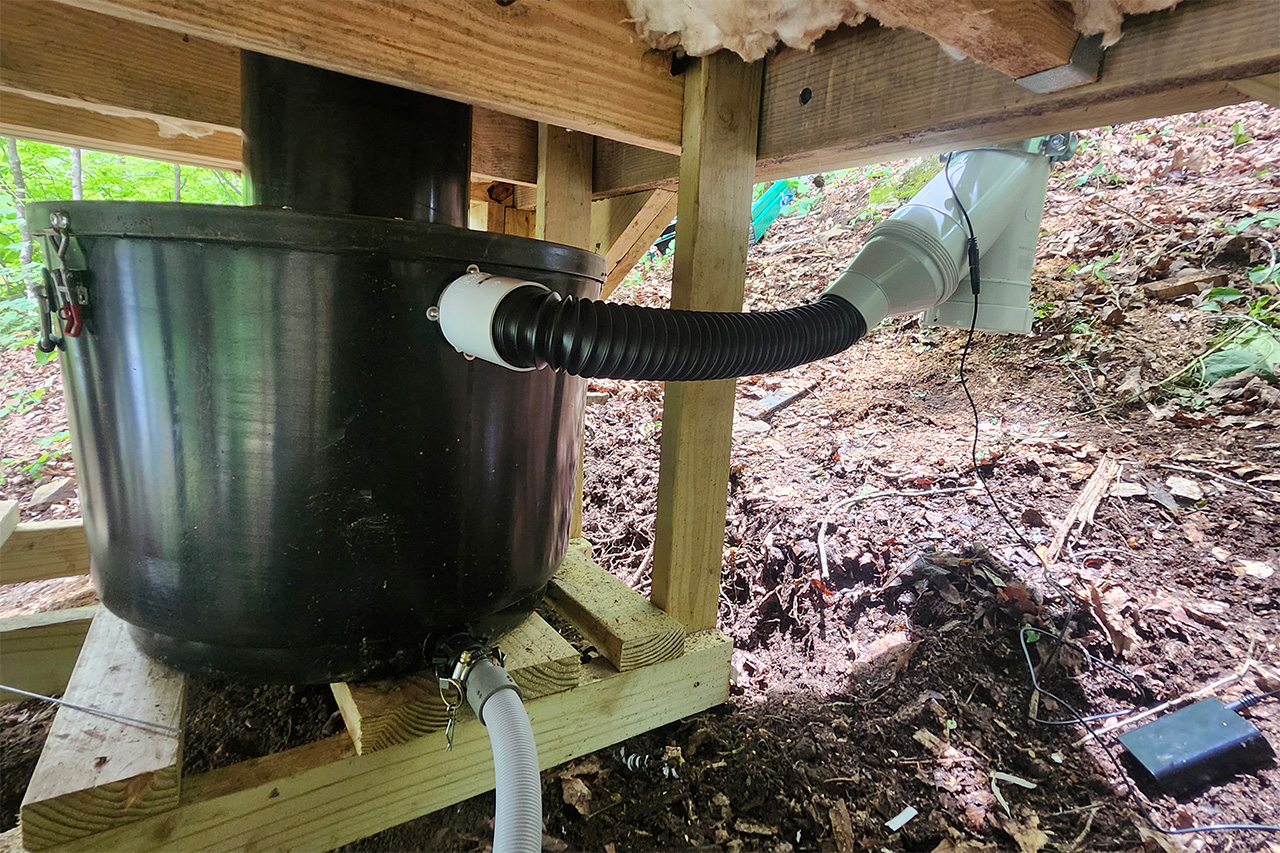
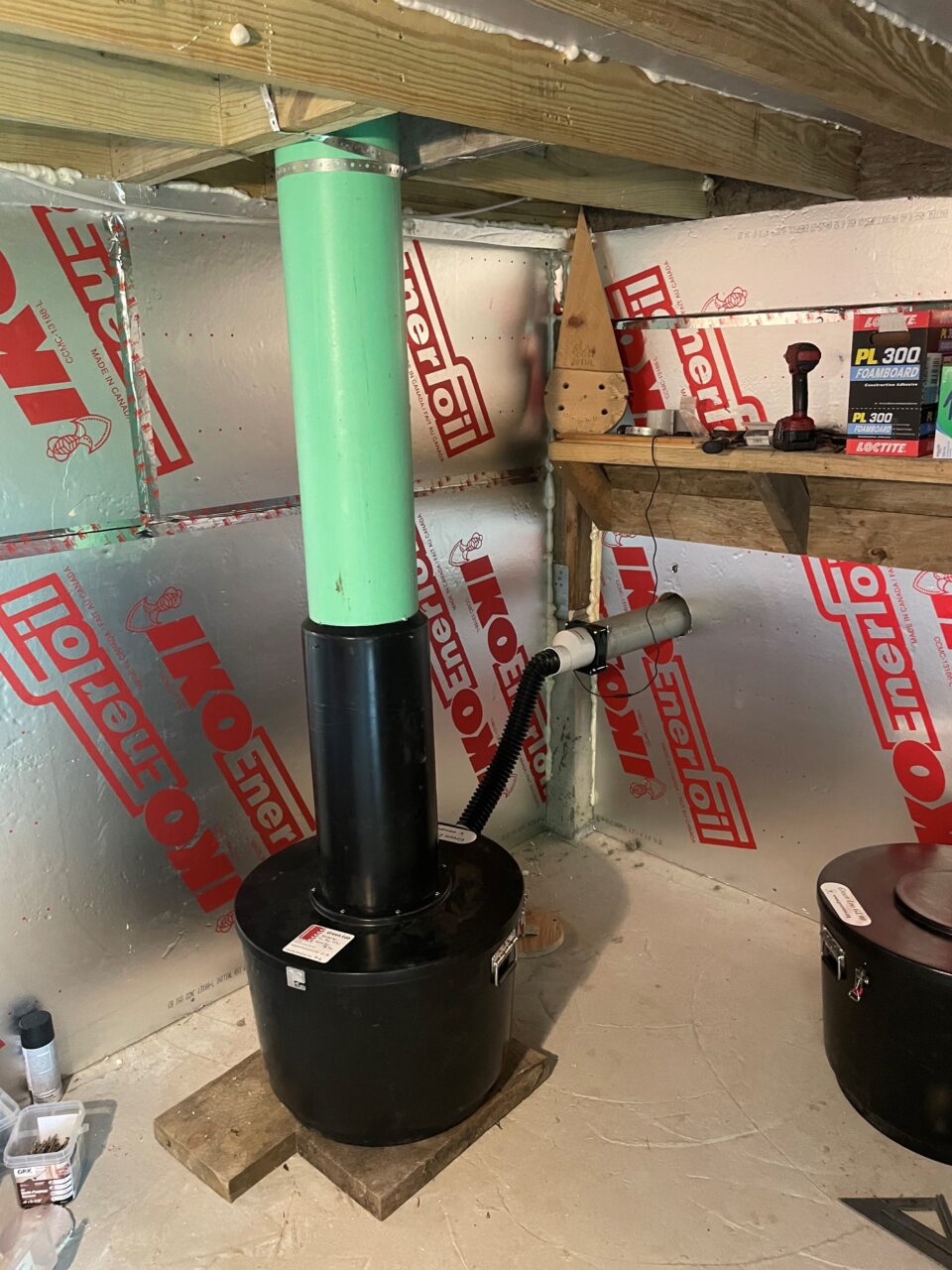
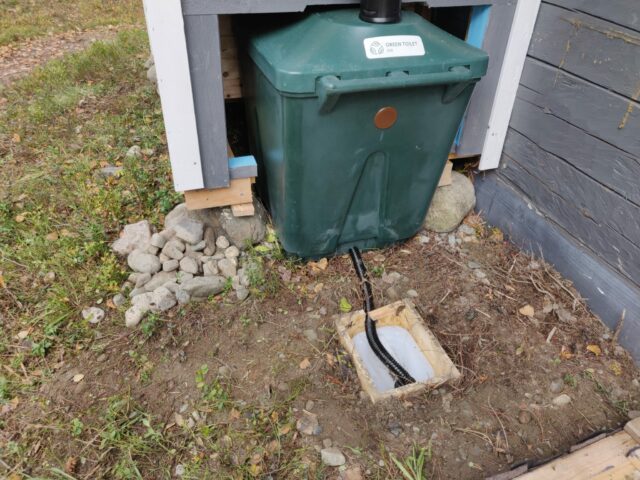
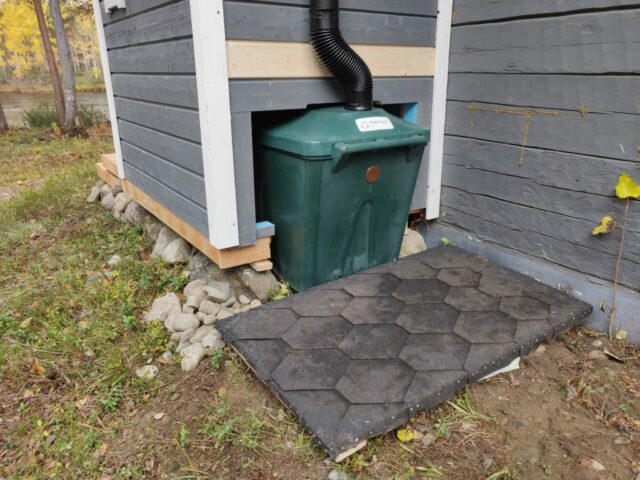
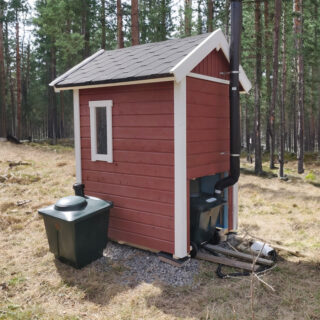
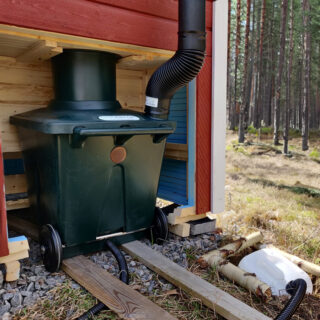
A black GL 90 composting container standing on timber under a cabin floor, with a ribbed vent hose and a liquid drain hose running from it
A real installation under a customer’s cabin. Two hoses leave the container: the ribbed black one is the vent, and the pale one at the base takes drained liquid away to a soakaway.

Ventilation — why the room stays fresh

A vent pipe runs from the chamber up through the roof, and a low-energy fan moves air through it continuously.

That airflow does two jobs at once. It carries moisture out, which keeps the pile from getting too wet, and it puts the chamber under slight negative pressure so air is always travelling down through the seat and out through the roof — never back up into the bathroom. It is the same reason a chimney draws.

This is why a correctly installed and vented waterless toilet is odor-free indoors, and why the vent pipe is not an optional extra.
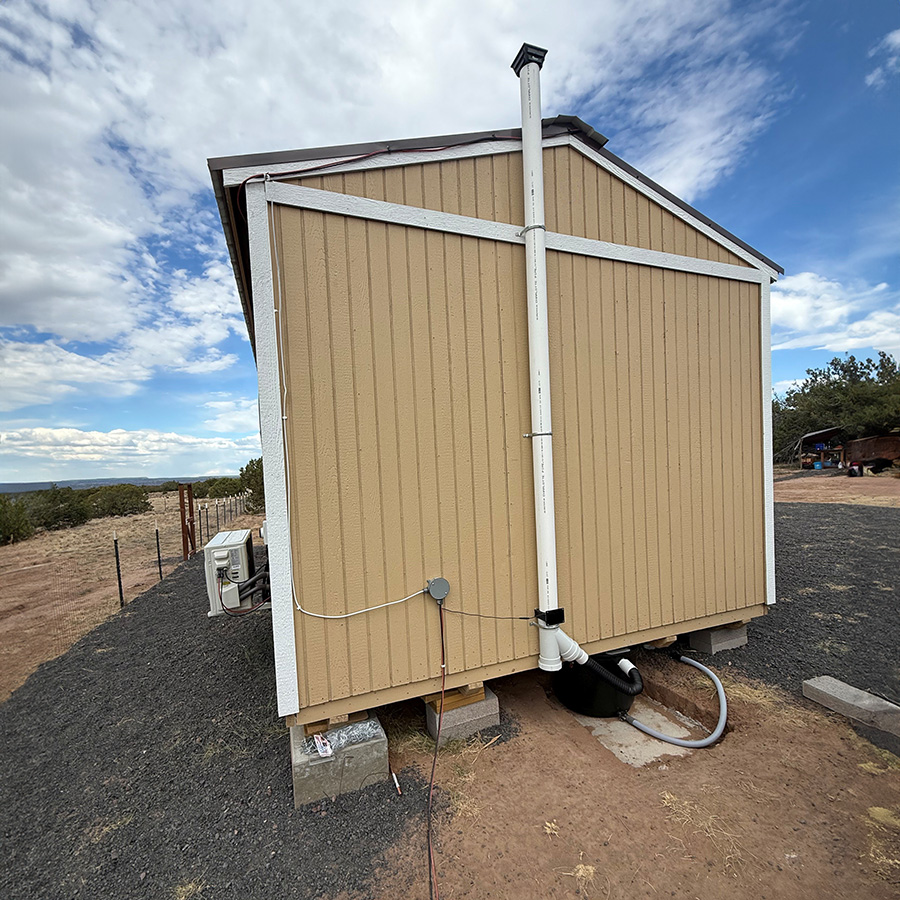
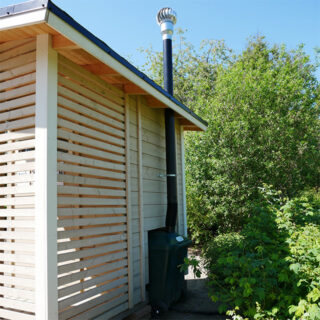
A white vent pipe running up the outside wall of a small off-grid building to above the roofline, with the composting container below the floor
The vent runs from the container up past the roofline, so anything it carries is released well above head height.

Two ways to build it: below-floor and above-floor

Every waterless toilet has to put the chamber somewhere. There are only two answers, and which one suits you is decided by your building, not by preference.

Below-floor, also called a split system

The pedestal sits in the bathroom and the chamber sits under the floor, out of sight, connected by a short chute. Waste drops straight down. Because the chamber is not limited by what fits in a bathroom, it can be much larger — which means more capacity and longer gaps between servicing. All the servicing happens outdoors, underneath the building, so nothing is carried through the house.

The requirement is clearance. You need usable space below the floor and a way to get to it.
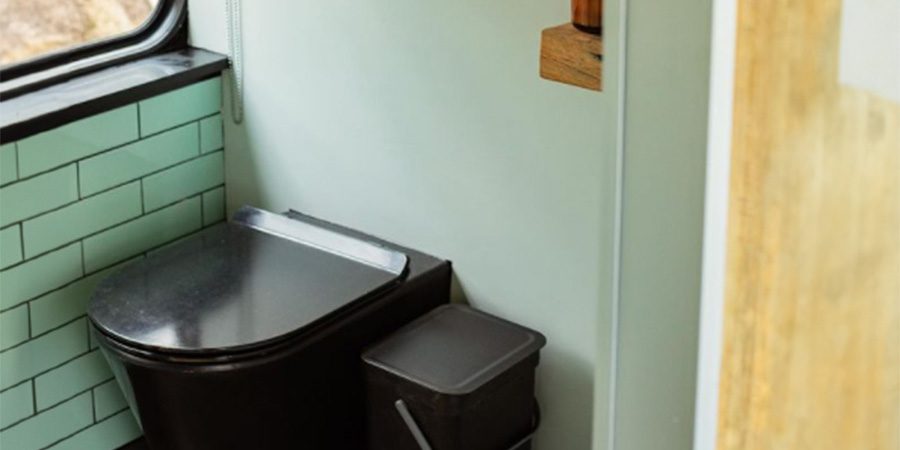
A black split-system toilet pedestal installed in a bathroom with green tiling

Above-floor, also called floor-standing

The chamber is inside the toilet unit itself, so the whole system sits on the bathroom floor. Nothing is needed below the floor at all, which makes it the answer for a slab, a ground-floor room, or any building with no crawl space. The trade is capacity: the chamber can only be as big as the unit, so it is serviced more often.
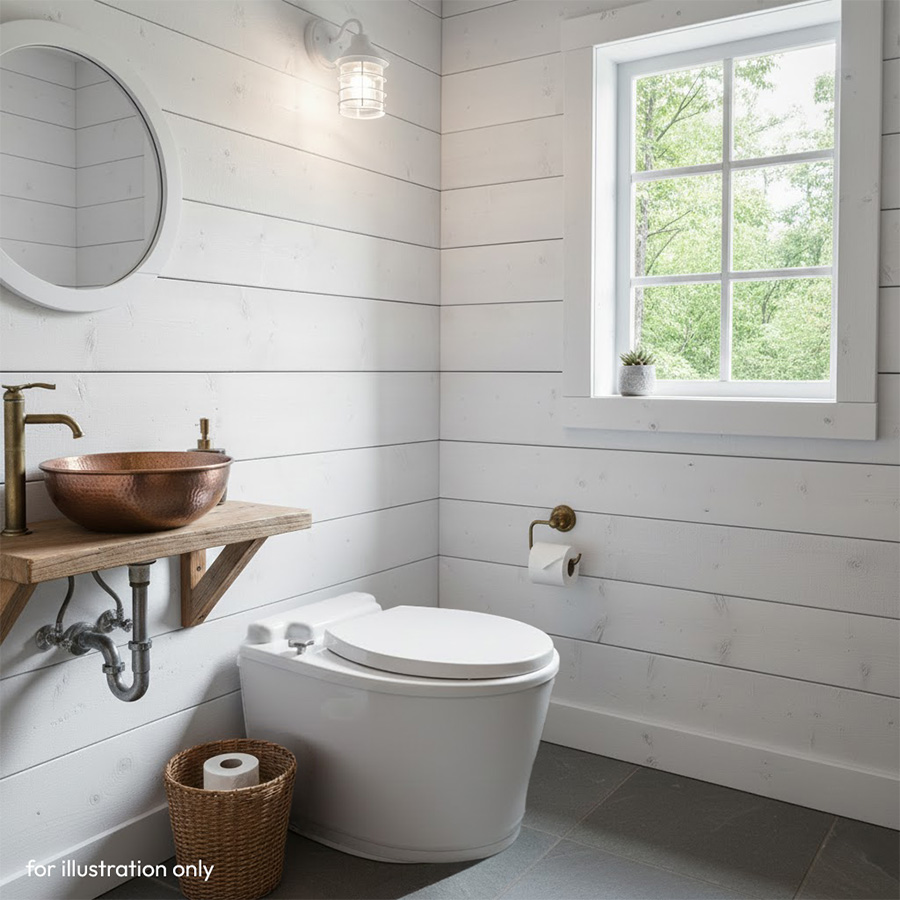
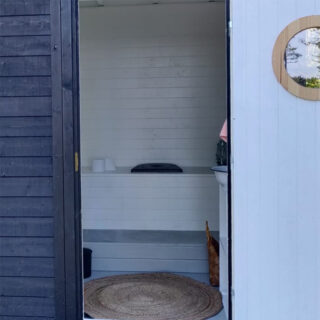
A white floor-standing waterless toilet in a modern cabin bathroom with white shiplap walls and a copper basin

Below-floor (split system) Above-floor (floor-standing)
Where the chamber sits Under the floor, out of sight Inside the toilet unit
Needs underfloor space Yes — and access to it No
Capacity Higher Limited by the size of the unit
Servicing interval Longer Shorter
Where servicing happens Outdoors, under the building At the unit
Typical fit Cabins and homes on piers or a crawl space Slab floors, ground-floor rooms, tiny homes

If you are not sure which one your building can take, the underfloor clearance is the question to answer first. Everything else follows from it.

Below-floor systems
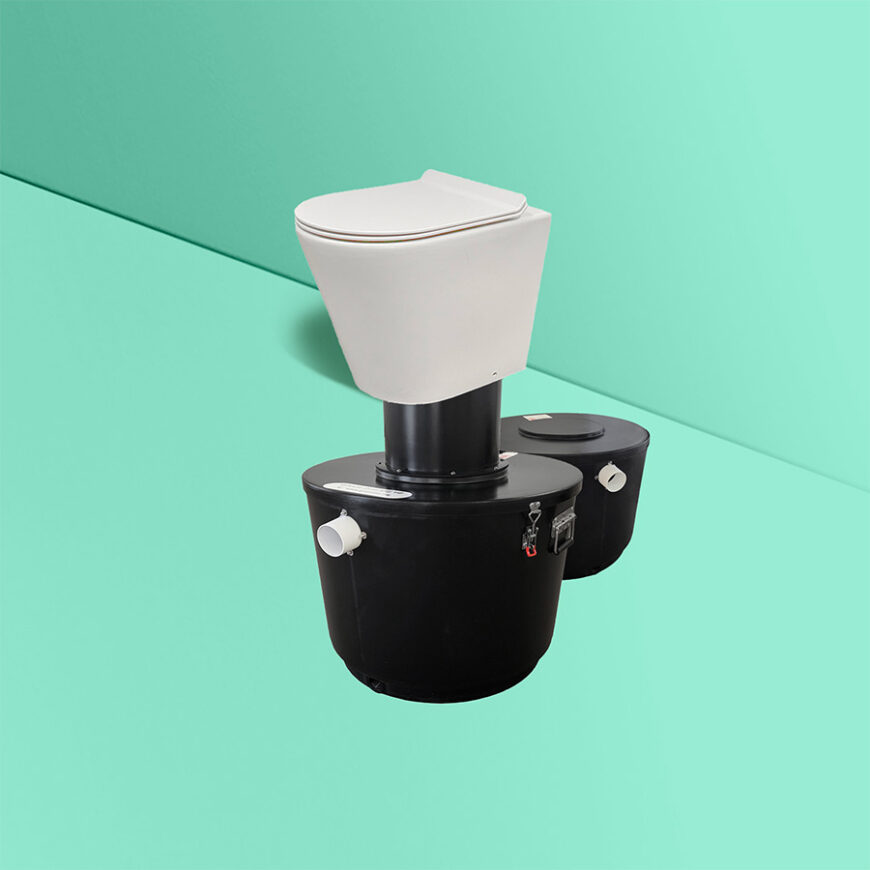
gl 90 batch composting toilet package

GL 90

Swappable bin system

$1,439.00
GL 55 batch composting toilet

GL 55

Swappable Bin System

$1,249.00
Green Toilet Lux 120 Composting toilet with spare container package black bins updated

Green Toilet Lux 120

Composting Toilet

$1,849.00
Green Toilet Lux 330 Composting toilet with spare container package updated black bins 2026

Green Toilet Lux 330

Swappable bin system

$1,989.00
New in
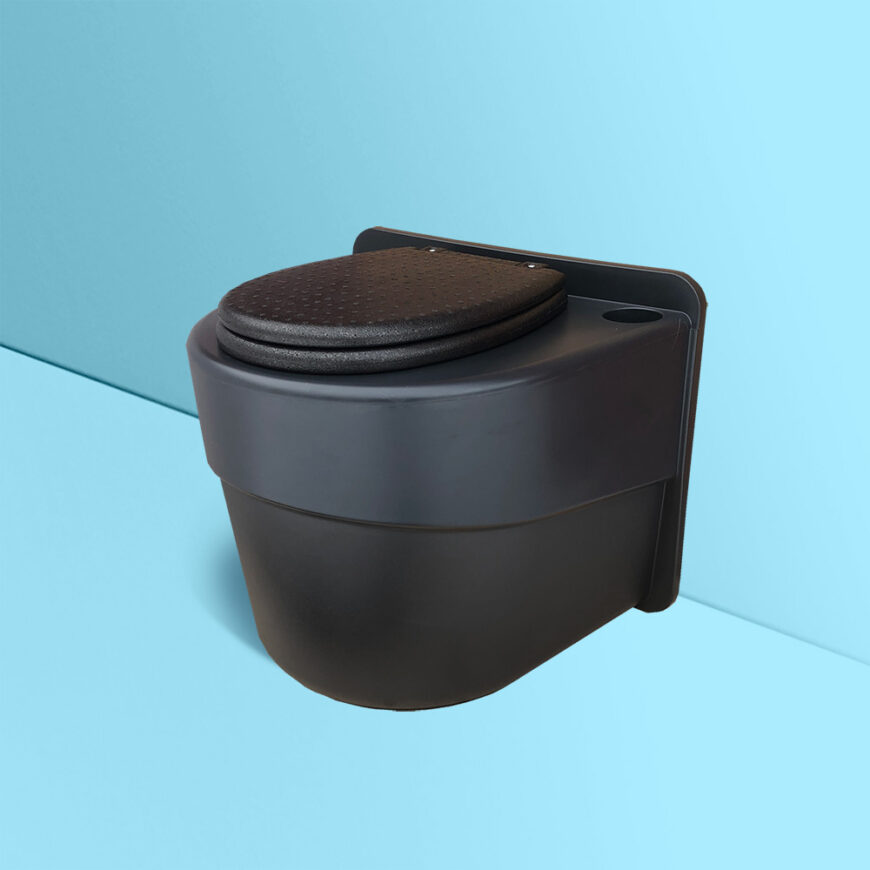
green toilet compact lux main product image green bg

Green Toilet Compact Lux

Premium Waterless Toilet

$1,549.00

Above-floor systems

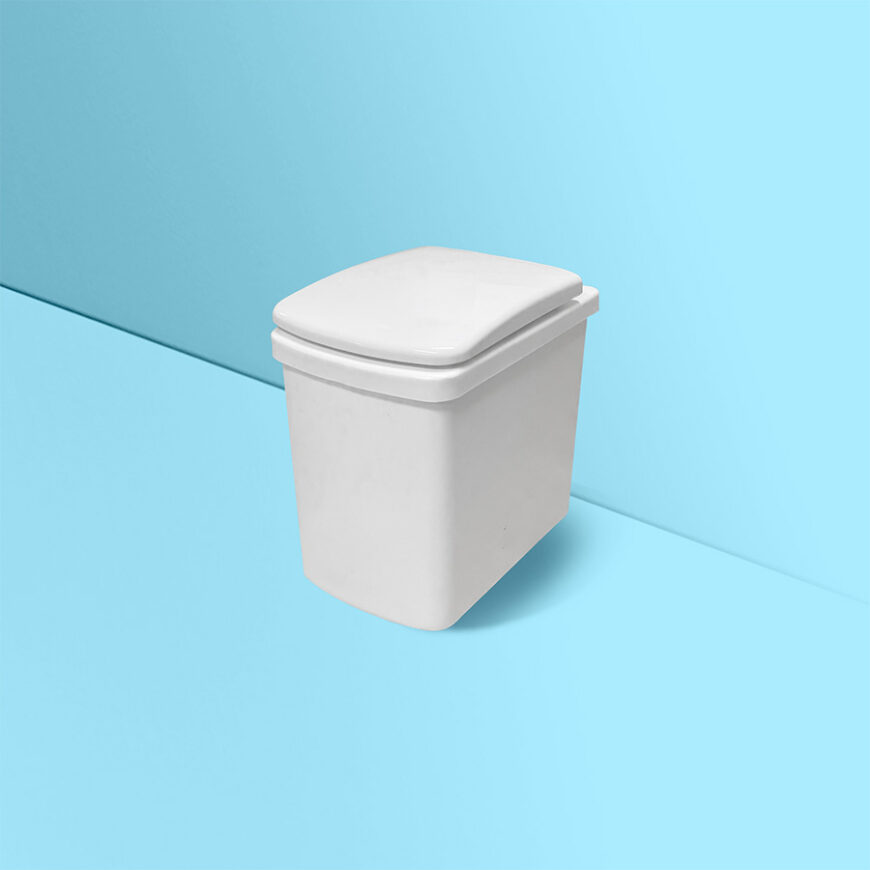
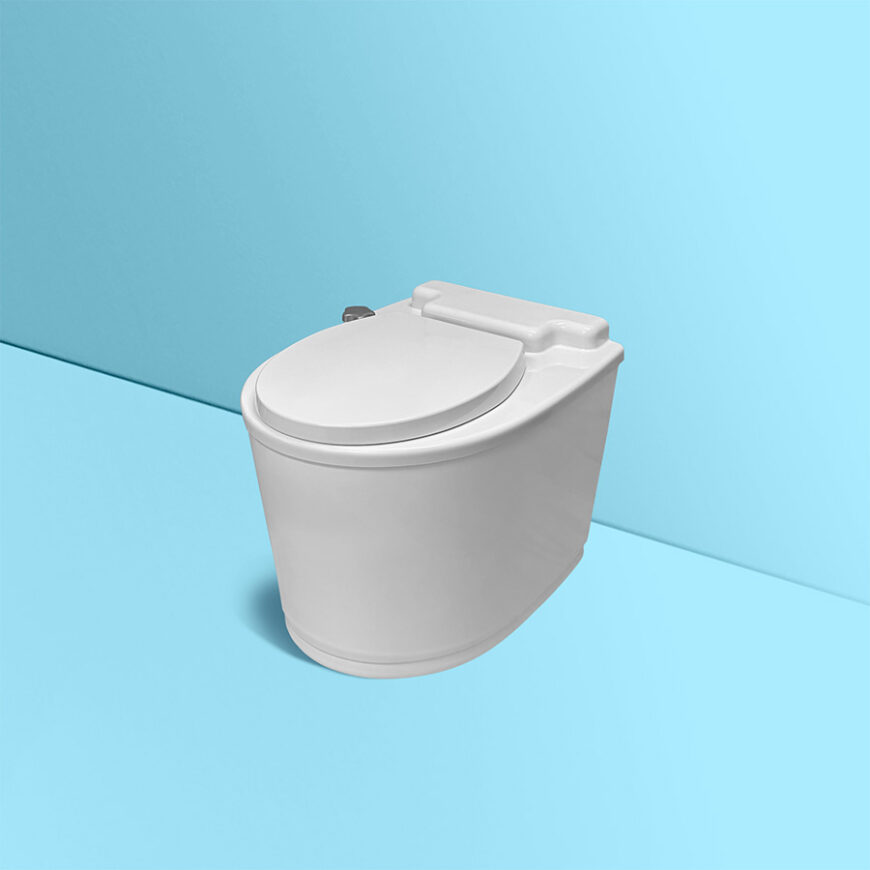
Green Toilet 100 Easy White Waterless Toilet Shop

Green Toilet 100 Easy White

Composting Toilet

$895.00
tiny pod self contained batch composting toilet

Tiny-Pod

Composting Toilet

$749.00
Oz-e-pod waterless composting toilet waterless toilet shop

Oz-e-Pod

Composting Toilet

$1,590.00
Green Toilet Light Urine Diverting Toilet

Green Toilet Light

Urine-diverting toilet

$749.00

What you end up with

Given air, the right moisture and time, the material in the chamber turns into compost — dark, crumbly and a fraction of the volume that went in. That reduction is why a chamber lasts as long as it does.

How servicing actually works

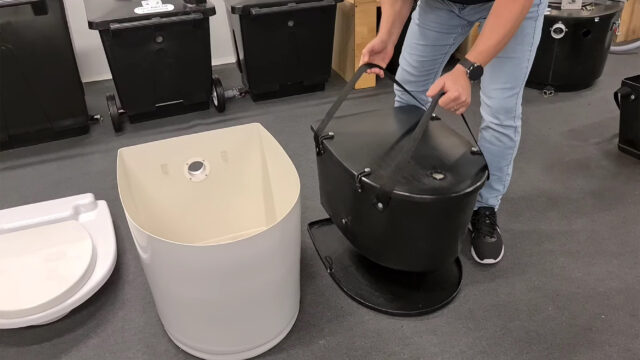
Most of our systems use batch composting with two containers. When one fills up, you seal it with a closed lid and leave it outside to finish composting, and you put the spare one into use. The toilet is back in service immediately. By the time the second container is full, the first has finished.

It takes minutes, it needs no tools, and it means nobody ever handles raw waste. If your household needs more capacity, the answer is usually another spare container rather than a bigger system.
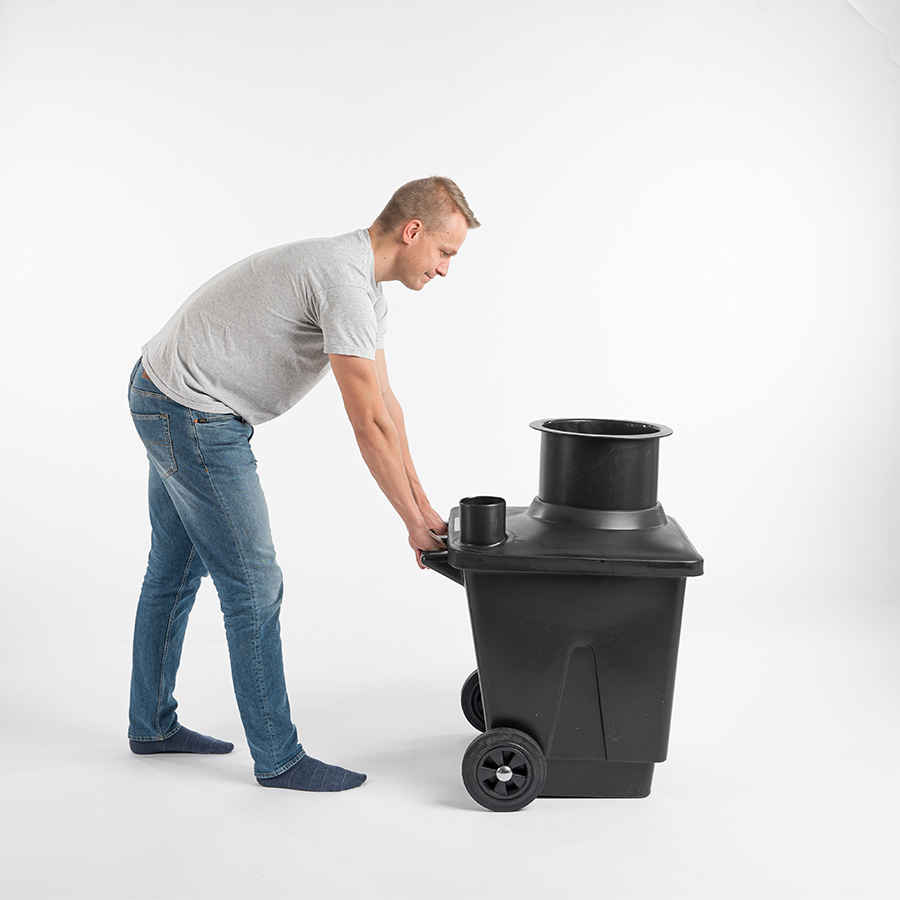
A man tilting a wheeled black composting container by its handle to move it
Larger containers are wheeled rather than lifted — servicing is a swap, not a haul.

Set up correctly, no — and usually far less than the conventional flush toilet you’re used to. Two things do the heavy lifting. The first is keeping the solids dry enough to compost: odor comes from solid waste that is too wet to break down properly, which happens in systems that do not separate liquid from the solids effectively. Many of our systems use a double-base design — urine and solids go into the composting bin together, most of the liquid is absorbed and evaporates away through the ventilation, and any excess drains through the double base and out of a liquid outlet underneath. If you would rather keep liquid out of the solids from the start, we also offer urine-diverting options. The second is continuous airflow, which draws air out of the composting bin through a vent, so any smell is pulled away from the unit.

It is not magic: a fan that is switched off, a blocked vent or a blocked liquid hose will cause smell — all easily avoided and easily fixed. Full answer in the FAQ.

Liquid separation keeps composting toilets odor-free and efficient by preventing excess moisture in the compost. It can be done directly at the toilet seat (urine-diverting toilets), where urine is diverted into a separate container, or within the composting container, where most liquid is absorbed or evaporates and only excess is managed.

Effective separation ensures proper composting conditions, controls odors, and allows the nutrient-rich urine or excess liquid to be repurposed as fertilizer for non-edible plants. Full answer in the FAQ.

First, the one people ask about most: yes, regular toilet paper is fine. Almost all commercial toilet paper is fully organic, so you can add it with confidence. Beyond that: urine and solid waste, a modest amount of water if you are cleaning, organic cleaning products, and bulking material.

Bulking material should be fully organic and compostable, dry, and a bit coarse rather than fine — anything that packs down too densely works against you. Wood shavings are a good example, and every one of our products ships with hemp shavings to get you started.

What does not belong in there: wet wipes, diapers, chemicals, cat litter, cigarette butts and feminine hygiene products. None of these compost, so they need a regular trash bin instead. Full answer in the FAQ.

Some do, some don’t — and where they do, it is a very small amount. Most of our composting models run a small 12V extractor fan that keeps air moving and waste drying. It draws roughly 3W — little enough to run continuously off a modest solar setup or leisure battery without you ever noticing it on your power budget.

Because the fan runs on low-voltage DC, it pairs naturally with our Solar Power Bank Kit. And if you want zero power, our Whirlybird wind-driven ventilator vents passively and needs no electricity at all — ideal for remote spots with no power source whatsoever. Full answer in the FAQ.

This depends entirely on your toilet model and how it is used — how many people, how often, and in what kind of setting. As a general rule, service intervals on our waterless toilets are measured in months, not weeks, for the vast majority of typical households. Larger households with daily, year-round use, or public and commercial settings, will see that interval shrink.

As a rule of thumb, the larger the compost bin and the bigger the model, the longer you will go between services — if you have the space to fit a genuinely large bin, that is not the place to cut costs. Past around ten daily users, the natural move is a second toilet rather than pushing a single unit beyond what it is built for. Full answer in the FAQ.

That depends far more on your climate than on the toilet. Heat speeds the process up and cold slows it right down. In a hot southern climate a batch can finish in 2–4 months over the summer, or 6–9 months over the winter. In the northern US, Canada or Alaska it can take 12–18 months. The month you service it in matters too: a container sealed in March has a whole summer to work on it, one sealed in October does not.

Plan on five to six months as an absolute minimum wherever you are. You will know it is finished because it stops looking and smelling like waste and starts looking like ordinary soil — trust that rather than the calendar. Even when it is finished, use it only on ornamental or non-food plants, never on vegetable beds.

This is exactly why the two-container method matters: the full container gets months to finish while the spare one is in use, so the process is never rushed. Full detail is in our FAQ on composting time.

Our FAQ Center answers around fifty questions in detail, from permits and installation to day-to-day cleaning and servicing.

Still deciding?

The fastest way to narrow it down is to answer a few questions about your building and how it will be used. Our waterless toilet finder does exactly that, and it will tell you honestly when none of our systems is the right fit.

If you would rather just ask a person, get in touch — tell us about your floor, your clearance and how many people will use it, and we will tell you what works.

Green Toilet Compact Lux

Average Daily Capacity per 26-Gallon Composting Bin

(Based on approx. 150 uses involving a #2 — i.e., poop) – only the solids count!

Service Interval #2 Visits per Day (involving a #2)
30 days (1 month) ~5.0 visits/day
60 days (2 months) ~2.5 visits/day
90 days (3 months) ~1.7 visits/day
180 days (6 months) ~0.8 visits/day
365 days (1 year) ~0.4 visits/day

👥 Roughly how often will I service a bin?

Full-Time Users Time Before a Bin Swap
1 person about 4–5 months
2 people about 2–3 months
3 people about 1.5–2 months
4 people about 1–2 months

🟢 What counts as a “#2 visit”?

Only visits that involve pooping (i.e., going number two) — urine-only visits don’t contribute to filling the composting bin and are not included in the estimate.

🔄 Why two bins?

The Green Toilet Compact Lux comes with two composting bins. The figures above are per bin: when one fills up you swap in the empty one, and the full bin is left to compost undisturbed until you next need it. The second bin doesn’t make the interval longer — it means you never have to empty a bin in a hurry. Additional bins can be added at any time.

⚠️ Disclaimer: These estimates are approximations. The actual number of solid uses per bin may vary significantly depending on climate, temperature, ventilation, user habits, and the amount of dry bulking material (e.g., wood shavings or peat) added after each use.

Our Customer Service team is currently closed on Thursday, June 11th, 2026 and will be back on Friday, June 12th, 2026.

In urgent matters, please email us at info@waterlesstoiletshop.com

Thank you for your patience and support.

Our phone customer service is closed today Friday, July 3rd 2026. We are back on Monday next week.
Email customer service remains available — please contact us at info@waterlesstoiletshop.com
, and we’ll get back to you as soon as possible.

Thank you for your understanding.

Klarna_Payment_Badge png

Pay with Klarna

We’re excited to now offer Klarna as a payment option at Waterless Toilet Shop!
Choose how you want to pay — all at once or with flexible installments that fit your budget.

💸 Pay in 4 — Interest-Free

Split your composting toilet purchase into four equal payments every two weeks.
No interest, no hidden fees — just a smarter way to pay over time.

Other Flexible Options

Klarna also offers monthly financing with 6–24-month plans and transparent APR rates based on your credit.
You’ll see all available payment options instantly when you select Klarna at checkout.

Klarna financing is issued by WebBank and available to eligible U.S. residents in most states.
Missed payments may incur late fees. For California residents, loans are made or arranged pursuant to a California Financing Law license. Review Klarna’s terms.

CF 8 Composting Toilet – Estimated Daily Capacity

The CF 8 is a continuous composting toilet system featuring a single large 250-gallon container. Like the CF 4, it is designed for gradual emptying rather than batch-style use. Solids are typically removed in thirds or sections, allowing earlier deposits time to fully compost inside the tank.

This setup allows for either:


🔁 Continuous Use: Gradual Emptying in Thirds

When used year-round, the CF 8 is typically emptied one-third at a time, effectively composting in three rotating “piles” within the container.

Because the CF 8 is more than twice as large as the CF 4, each pile can hold approximately 480–960 poops, depending on composting conditions and how much bulking material is used.

Service Interval (per pile) Estimated #2 Visits per Day
30 days (1 month) ~17–32 visits/day
60 days (2 months) ~8–16 visits/day
90 days (3 months) ~5–11 visits/day
180 days (6 months) ~3–5 visits/day
365 days (1 year) ~1.2–2.6 visits/day

💡 These figures assume that one-third of the tank is in active use at a time, with older waste given time to compost before removal.


🌤 Seasonal Use: Full-Tank Emptying After Inactive Period

For cabins, cottages, or other sites used seasonally, the CF 8 can be used for a few months and then left idle to allow full composting. In such cases, the entire tank may be emptied once a year.

Full-tank capacity estimate: ~1,440–2,880 poops

Example: 120 days of use (approx. 4 months):
→ ~12–24 solid visits per day on average


⚠️ Disclaimer

These numbers are rough estimates based on typical use and conditions. Actual capacity will vary depending on:

For best performance, ensure proper aeration, regular bulking material use, and consistent emptying of composted portions.


💡 Want to Maximize Capacity? Consider a Urine-Diverting Toilet — With Some Important Considerations

upgrade to a urine diverting toilet pedestal

If you’re looking to maximize the capacity of the CF 8 system — aiming for 960+ poops per composting “pile” — we recommend using a urine-diverting (UD) toilet pedestal.

✅ Benefits of Urine Separation:

By diverting urine out of the solids container, the volume taken up by absorbent material (like peat or wood shavings) is significantly reduced. This can make a big difference in how often the system needs to be emptied.


⚠️ Downsides to Consider:

Urine-diverting toilets can take some time to get used to. Users need to sit or aim correctly to ensure proper separation, which might not happen consistently without experience or guidance.

For this reason, UD toilets are generally not ideal for public or commercial settings where the toilet is used by guests, tourists, or other first-time users. In these cases, misuse can reduce the effectiveness of the system and may even lead to unpleasant maintenance issues.


In short: A UD toilet is an excellent choice for maximizing capacity in private or family use, but for guest or public access composting toilets, a standard non-diverting model may be more practical and user-friendly.

Green Toilet 100 Easy – Estimated Daily Capacity

The Green Toilet 100 Easy is a compact and user-friendly batch composting toilet with a 26-gallon composting container. Its design makes it well-suited for outhouses, cabins, and even indoor use. A spare container is available to expand capacity and simplify servicing.


🔢 Estimated Solid-Waste Capacity per Bin:

Note: Due to the shape and internal structure of the container, the actual composting capacity is slightly lower than its raw volume might suggest, if you compare with Green Toilet 120 Family composting toilet for example.


📆 Average Daily Capacity per Bin

Service Interval Estimated #2 Visits per Day
30 days (1 month) ~6–7 visits/day
60 days (2 months) ~3–4 visits/day
90 days (3 months) ~2.2 visits/day
180 days (6 months) ~1.1 visits/day
365 days (1 year) ~0.5 visits/day

Notes & Recommendations:


⚠️ Disclaimer:
These estimates are intended as general guidance. Real-world performance may vary depending on:

CF 4 Composting Toilet – Estimated Daily Capacity

The CF 4 is a continuous composting toilet system featuring a single large 105-gallon container. Unlike batch composting systems (such as the Green Toilet models), the CF 4 is designed for gradual emptying — solids are typically removed in thirds or sections, allowing earlier deposits time to fully compost inside the tank.

This setup allows for either:


🔁 Continuous Use: Gradual Emptying in Thirds

When used year-round, the CF 4 is typically emptied one-third at a time, effectively composting in three rotating “piles” within the container. Depending on composting conditions and how much bulking material is used, each pile can hold approximately 200–400 poops.

Service Interval (per pile) Estimated #2 Visits per Day
30 days (1 month) ~7–13 visits/day
60 days (2 months) ~3–7 visits/day
90 days (3 months) ~2–4 visits/day
180 days (6 months) ~1–2 visits/day
365 days (1 year) ~0.5–1.1 visits/day

💡 These figures assume that one third of the tank is in active use at a time, with older waste given time to compost before removal.


🌤 Seasonal Use: Full-Tank Emptying After Inactive Period

For cabins, cottages, or other sites used seasonally, the CF 4 can be used for a few months and then left idle to allow full composting. In such cases, the entire tank may be emptied once a year.


⚠️ Disclaimer

These numbers are rough estimates based on typical use and conditions. Actual capacity will vary depending on:

For best performance, ensure proper aeration, regular bulking material use, and consistent emptying of composted portions.


💡 Want to Maximize Capacity? Consider a Urine-Diverting Toilet — With Some Important Considerations

upgrade to a urine diverting toilet pedestal

If you’re looking to maximize the capacity of the CF 4 system — aiming for 400+ poops per composting “pile” — we recommend using a urine-diverting (UD) toilet pedestal.

✅ Benefits of Urine Separation:

By diverting urine out of the solids container, the volume taken up by absorbent material (like peat or wood shavings) is significantly reduced. This can make a noticeable difference in how often the system needs to be emptied.

⚠️ Downsides to Consider:


In short: A UD toilet is an excellent choice for maximizing capacity in private or family use, but for guest or public access composting toilets, a standard non-diverting model may be more practical and user-friendly.

Green Toilet 120 Family

💩 Average Daily Capacity per 31-Gallon Composting Bin

(Based on approx. 356 uses involving a #2 — i.e., poop) – only the solids count!

Service Interval #2 Visits per Day (involving a #2)
30 days (1 month) ~11.9 visits/day
60 days (2 months) ~5.9 visits/day
90 days (3 months) ~4.0 visits/day
180 days (6 months) ~2.0 visits/day
365 days (1 year) ~1.0 visits/day

🟢 What counts as a “#2 visit”?
Only visits that involve pooping (i.e., going number two) — urine-only visits don’t contribute to filling the composting bin and are not included in the estimate.

⚠️ Disclaimer:
These estimates are approximations. The actual number of solid uses per bin may vary significantly depending on climate, temperature, ventilation, user habits, and the amount of dry bulking material (e.g., wood shavings or peat) added after each use.

Green Toilet 330

💩 Average Daily Capacity per 87-Gallon Composting Bin

(Based on approx. 1,000 uses involving a #2 — i.e., poop) – only the solids count!

Service Interval #2 Visits per Day (involving pooping)
30 days (1 month) ~33 visits/day
60 days (2 months) ~17 visits/day
90 days (3 months) ~11 visits/day
180 days (6 months) ~5.6 visits/day
365 days (1 year) ~2.7 visits/day

🟢 What counts as a “#2 visit”?
Only visits that involve defecation (pooping) — urine-only visits don’t fill up the composting bin and are not included in the 1,000-use estimate.

⚠️ Disclaimer:
These estimates are based on typical, steady use. The actual number of solid uses a composting bin can handle may vary significantly depending on climate, temperature, humidity, ventilation, and how much dry bulking material (like wood shavings) is added after each use.

Composting toilet waste pipe extension

💧 Liquid waste (urine) estimate

Average person produces about:

So for 100 people:


🚽 Flush water use estimate

Average flush volume in the U.S. is about:

Average person flushes ~5 times per day, so:

So for 100 people:


✅ Summary in gallons

Type Per person For 100 people
Urine (liquid waste) ≈0.4 gal/day ≈40 gal/day
Flush water (toilet only) ≈7.5 gal/day ≈750 gal/day
Product Image Product Clearance Requirement
CF 4 continuous composting toilet with porcelain pedestal green background CF 4 Continuous composting toilet 13″ (when partially buried)
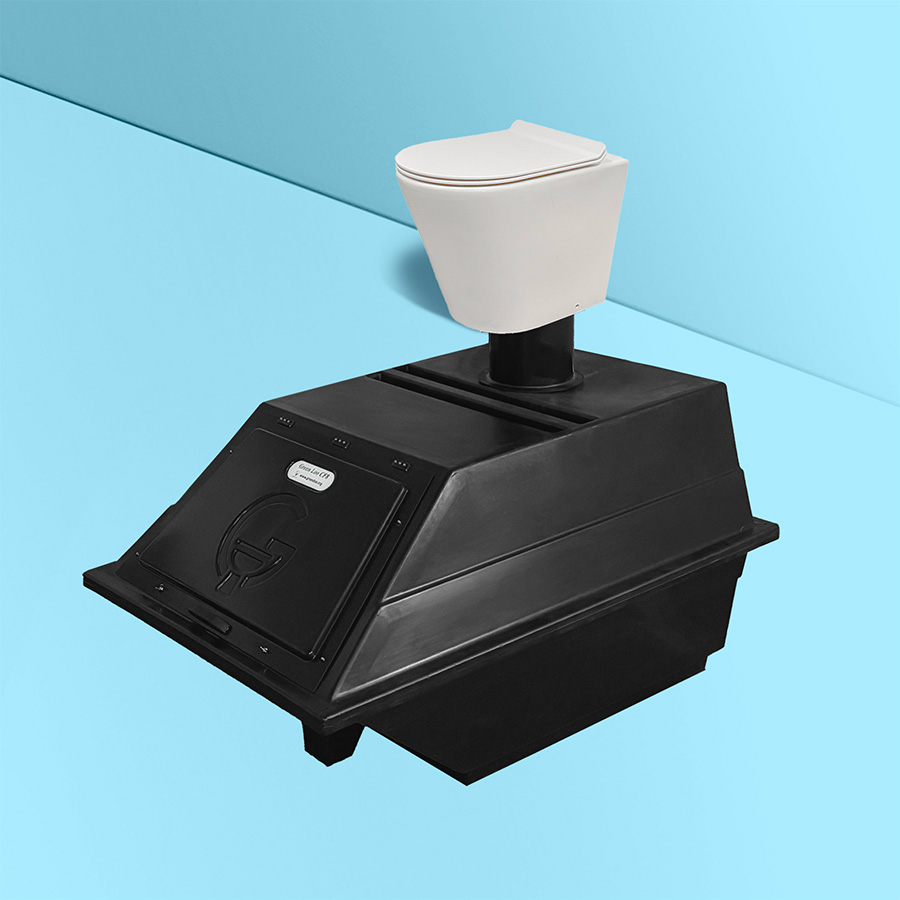
gl 90 batch composting toilet package GL 90 Batch composting toilet 18″
CF 8 continuous composting toilet with non separating porcelain pedestal blue background CF 8 Continuous composting toilet 18″ (when partially buried)
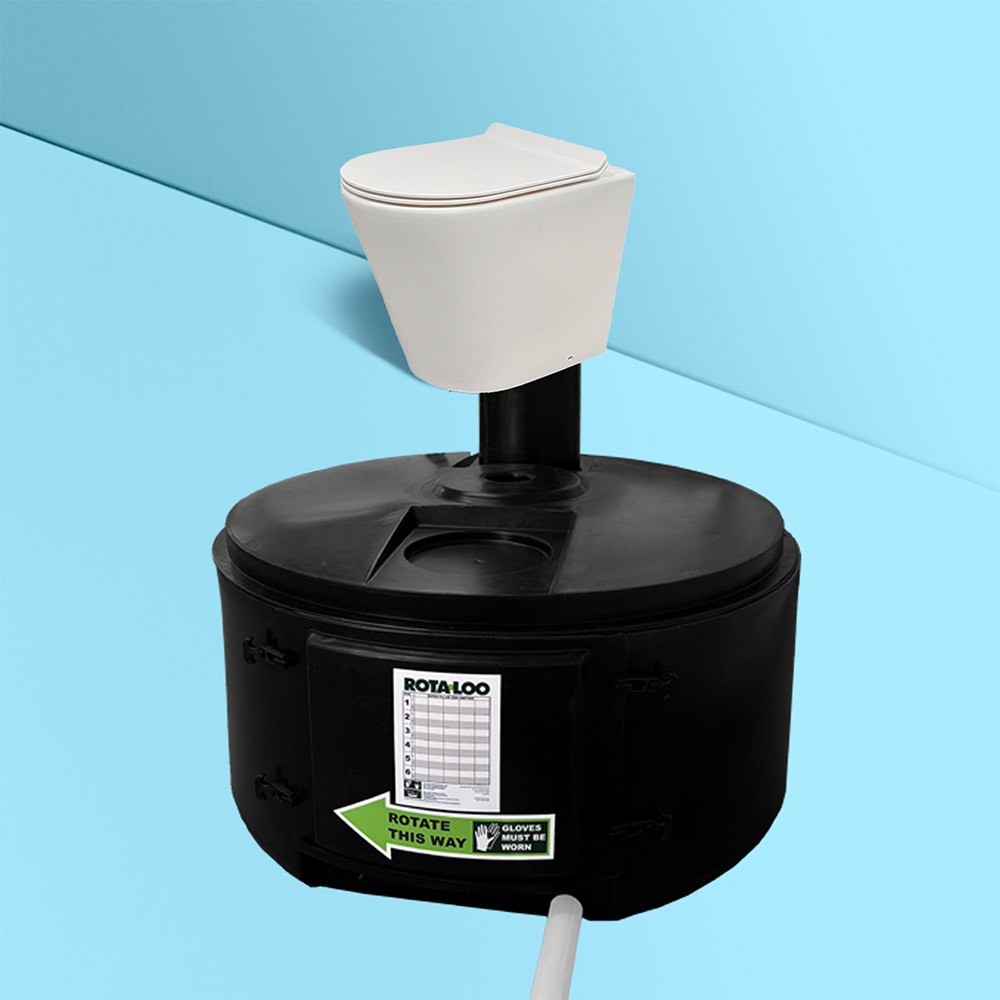
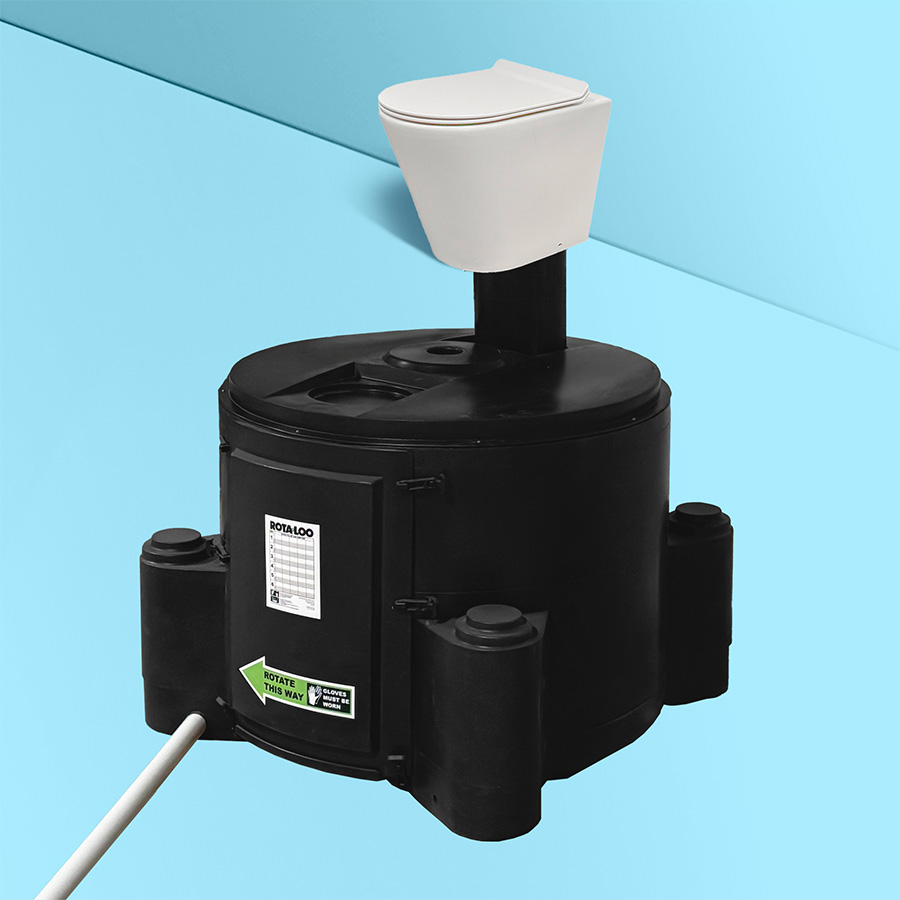
Rota-Loo 650 Split-system Batch Composting Toilet Rota Loo 650 Batch composting toilet 26″
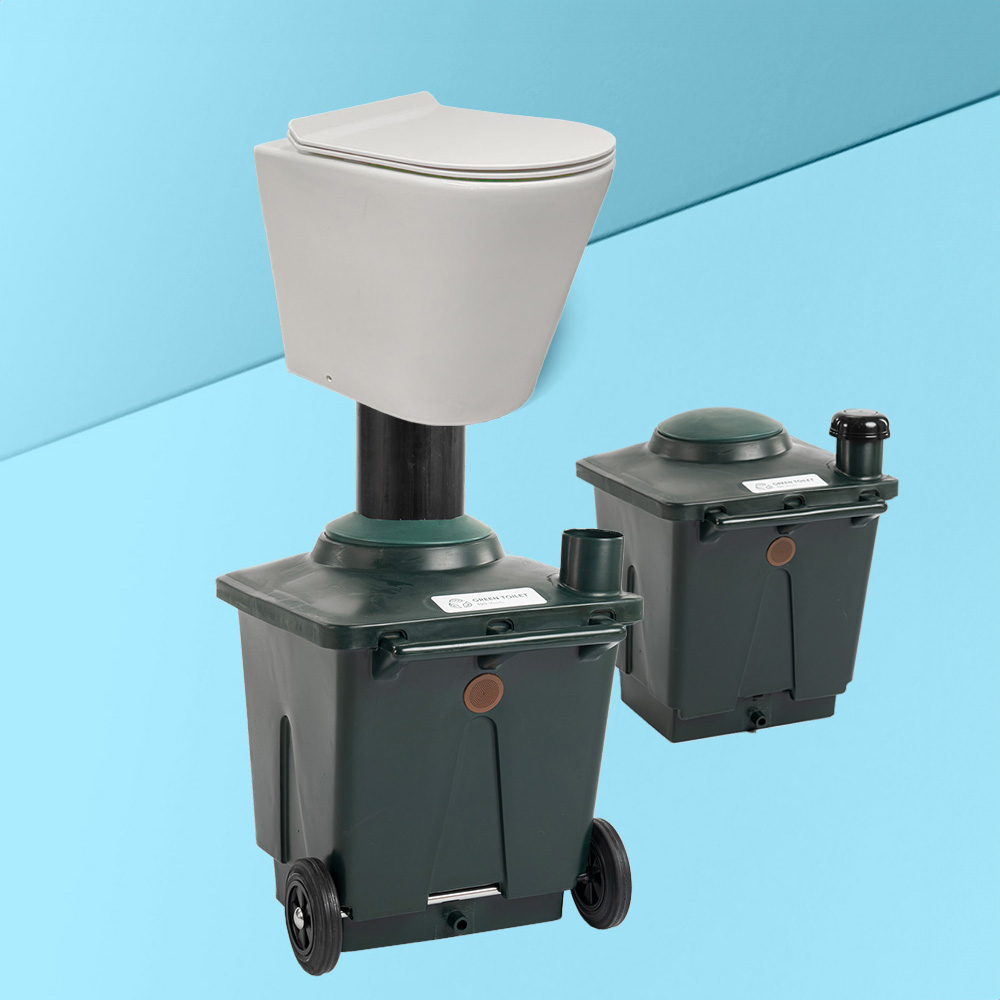
Green Toilet Lux 120 Composting toilet with spare container package Green Toilet Lux 120 Batch composting toilet 28″
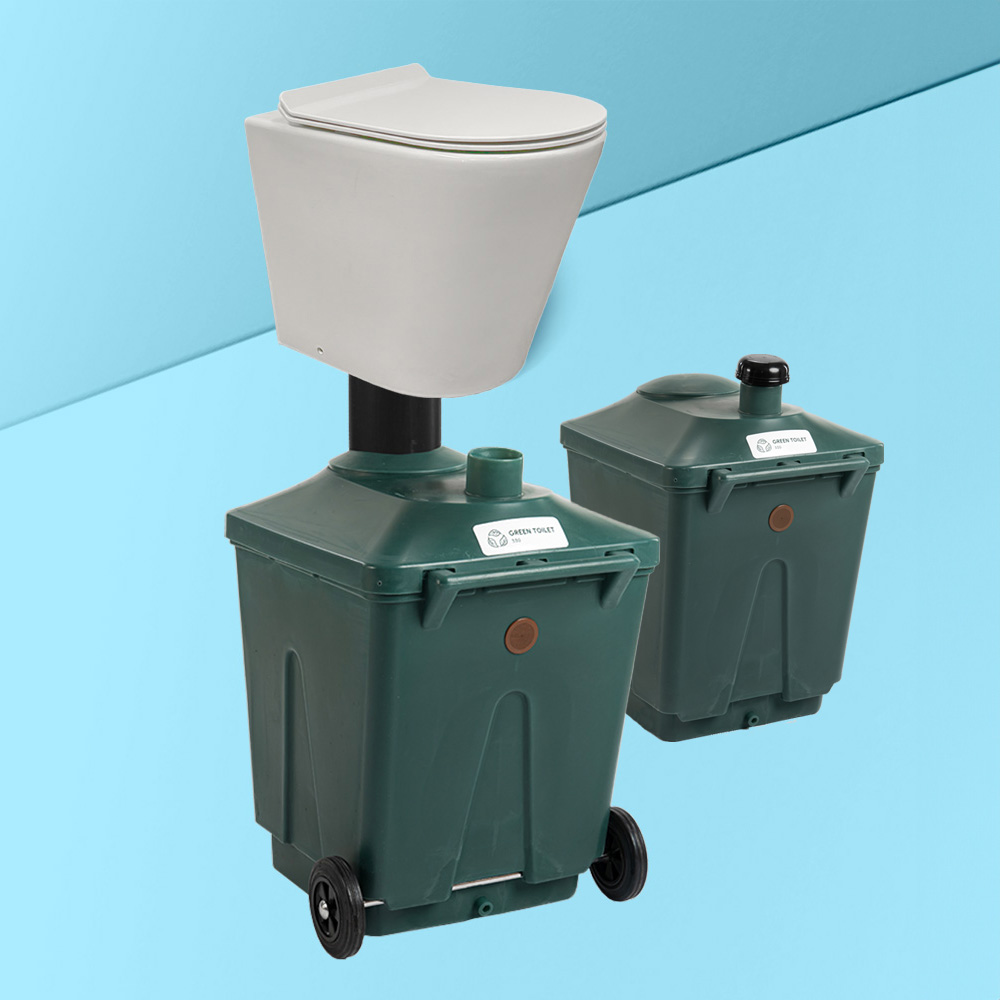
Green Toilet Lux 330 Composting toilet with spare container package Green Toilet Lux 330 Batch composting toilet 37″
Rota Loo 950 batch composting toilet blue background Rota Loo 950 Batch composting toilet 38″

📞 Customer Service Hours
We’re here to help!

📱 Phone: 1-702-328-0689
💬 Live Chat: Start a Chat Now

Our team is always available to assist you during the following hours:

Monday – Friday: 6:00 AM – 2:00 PM Pacific Time
Saturday – Sunday: Closed
Holidays: Closed

Have a question outside of our service hours?
Feel free to leave us a message through our contact form or email us at info@waterlesstoiletshop.com.

We’ll get back to you as soon as possible on the next business day.

WTS Logo

Urine Separation in Composting Toilet Article

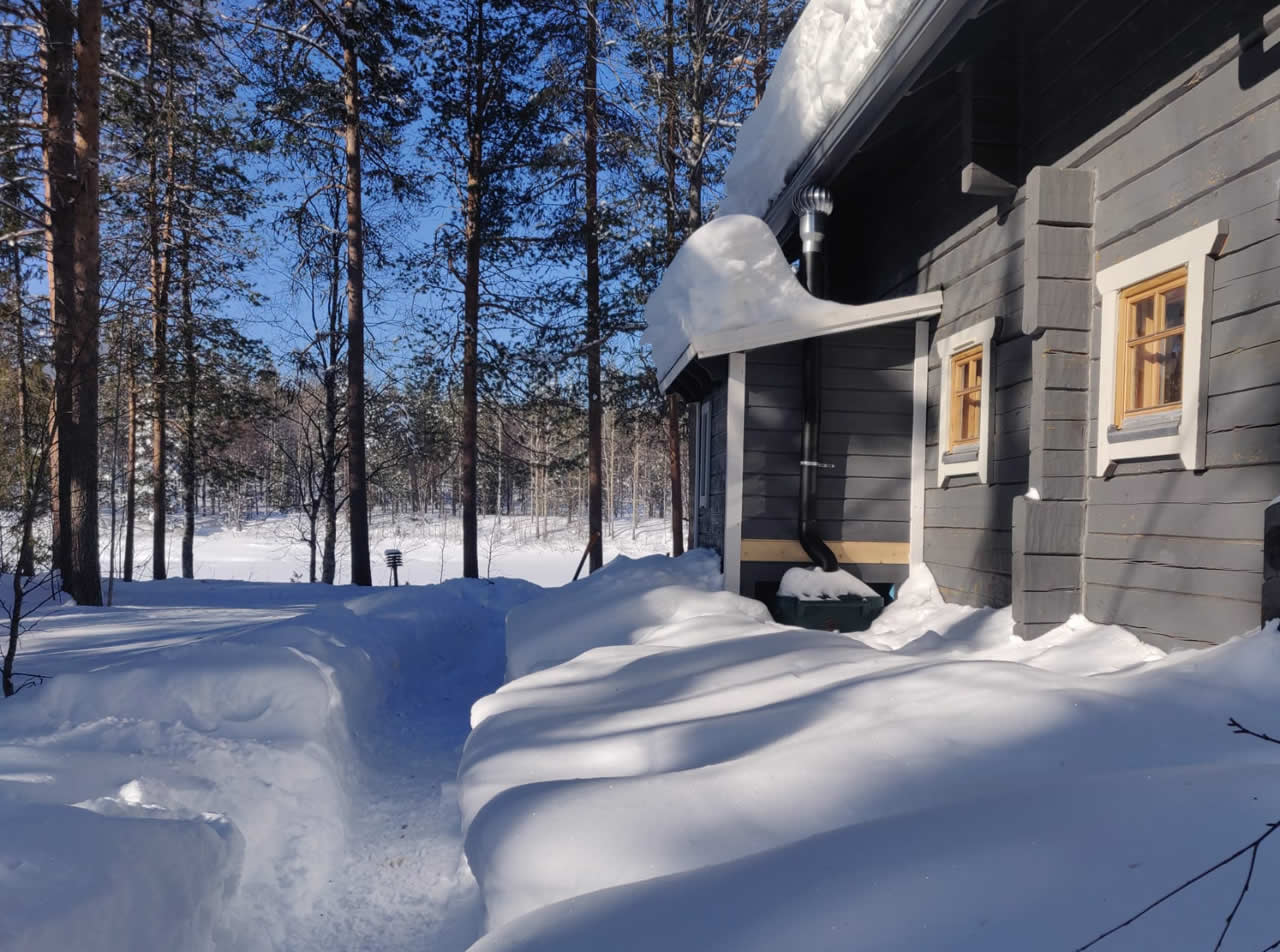
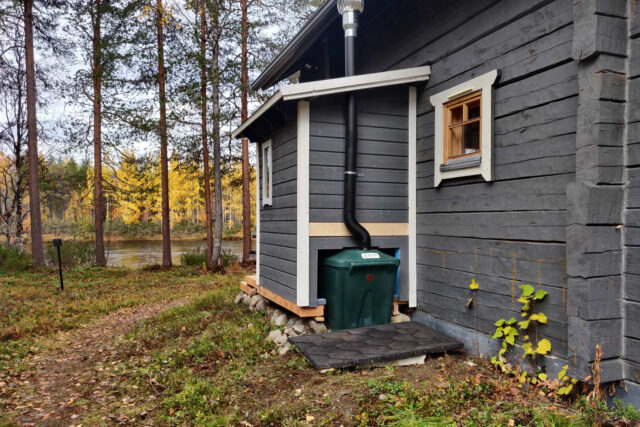
outhouse next to winter cottage (1)

outhouse next to winter cottage


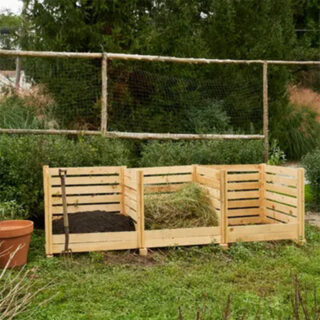
open compost bin outdoors

open back bench-type-of seat
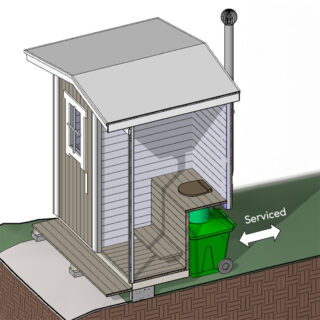
Installation principle of Green Toilet 120 and 330

Green Toilet 120 Family composting toilet installed

Green Toilet 120 Family installed underneath outhouse seat

Green Toilet 330 outhouse inside flat seat

Green Toilet 330 ventilation pipes

Green Toilet features ventilation pipes.

On top of the vent pipe stack here is a Whirlybird

Green Toilet double base from below

Green Toilet’s double base from below

Green Toilet 120 Family double base photo Green Toilet 120 compost bin parts photo updated black bin

My cart
Your cart is empty.

Looks like you haven't made a choice yet.